
 The Kerr Center for Sustainable Agriculture
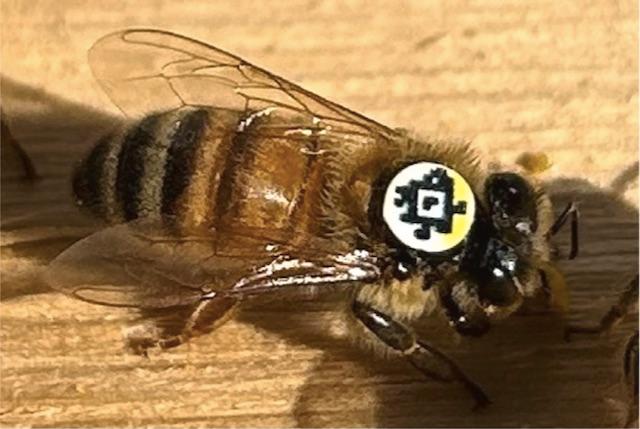
In today’s world, it’s hard to think of anything that doesn’t have a QR code slapped onto it. A team of researchers at Pennsylvania State University has just made it a little bit harder, by tagging honeybees with QR codes.
Scanning these bees with your phone’s camera won’t take you to a website advertising their honey – or much of anywhere, really. But a camera mounted on the hive entrance can scan the codes to keep track of when individual bees enter or leave – giving researchers an unprecedented view of the bees’ foraging behavior.
The traditional approach to such research required researchers to sit and observe the hives, usually for an hour or so a day for a few weeks, and identifying individual bees was a daunting challenge. The new, QR code-based approach works 24/7, during the entire period the bees are active, and recognizes each individual bee of the tens of thousands tagged by researchers.
“This technology is opening up opportunities for biologists to study systems in ways that weren’t previously possible, especially in relation to organic beekeeping,” said Margarita López-Uribe, the study’s lead author.
The relevance to organic honey production lies in the uncertainty around how far bees typically travel on foraging flights. The National Organic Standards Board has grappled in the past with how close certified organic beehives could be located to fields where prohibited pesticides were in use.
Since researchers put the QR codes on newly-hatched bees, the study is also yielding insights on how bees’ foraging behavior changes over the course of their lives – and even on how long they live. “We’re seeing bees foraging for six weeks, and they don’t start foraging until they are already about two weeks old, so they live a lot longer than we thought,” said Robyn Underwood, a co-author on the study.
In the future, the team hopes to correlate the QR code data with the bees’ “dances” to gain a better understanding of how the dance encodes the location information of nectar and pollen sources.
Additionally, they plan to tag other kinds of honeybees – drones and queens – as well as other bee species. The researchers will also conduct workshops for beekeepers interested in deploying the technology to monitor their own operations.
The study was published in HardwareX.


Get Local News!
